
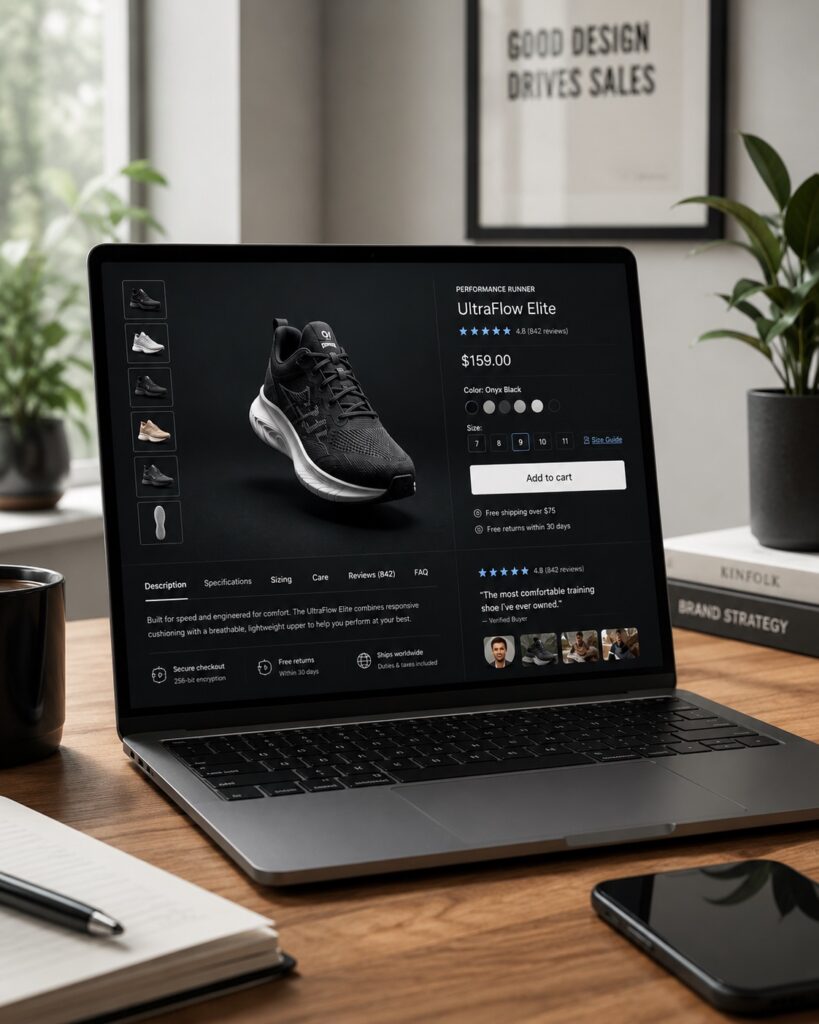
7 Proven High-Converting Product Page UX Patterns That Drive More Sales
Every eCommerce growth conversation eventually arrives at the same destination: the product page.
Brands invest heavily in paid media, SEO, email marketing, social commerce, and content creation to attract visitors. Yet the page responsible for turning that traffic into revenue is often overlooked. A product page can have beautiful photography, premium branding, and compelling copy, and still underperform because conversion isn’t determined by appearance alone.
A high-converting product page succeeds because it removes friction. It answers customer questions before they become objections, builds trust before doubt appears, and creates a seamless path from product discovery to purchase.
The difference between an average product page and a high-converting product page often comes down to a handful of UX decisions that help shoppers make confident buying decisions without leaving the page.
What Is a High-Converting Product Page?
A high-converting product page is designed to reduce uncertainty throughout the customer journey.
Instead of forcing shoppers to search for answers, compare multiple tabs, or contact customer support, the page delivers the right information at the exact moment it is needed.
The best product pages combine:
- Conversion-focused UX design
- Product storytelling
- Mobile-first usability
- Strategic merchandising
- Trust-building elements
- Search engine optimization
When these elements work together, the product page becomes one of the most powerful revenue-generating assets in an eCommerce business.
1. Multi-Image Variants Reduce Purchase Uncertainty
One of the most common reasons customers abandon a product page is uncertainty.
A shopper selects a different color or style, and the product image doesn’t change. Instead of seeing the exact product they are considering, they are forced to imagine it.
A high-converting product page solves this by connecting every variant to its own image gallery. When customers select a color, material, or configuration, the imagery updates immediately.
Why Multi-Image Variants Matter
- Increase customer confidence
- Reduce return rates
- Improve product understanding
- Support purchasing decisions
- Create a premium shopping experience
The goal is simple: let the photography answer questions before customers need to ask them.
2. Sticky Add-to-Cart Bars Preserve Buying Intent
Most shoppers do not make a purchase decision immediately.
They scroll through product descriptions, sizing information, customer reviews, specifications, and FAQs before deciding to buy.
Unfortunately, many product pages allow the primary conversion action to disappear during this process.
A high-converting product page uses a sticky add-to-cart bar that keeps pricing, variants, and purchase actions visible regardless of scroll depth.
Benefits of Sticky Add-to-Cart UX
- Reduces friction
- Improves mobile usability
- Increases conversion opportunities
- Keeps buying intent connected to action
- Creates a smoother shopping experience
For Shopify and Shopify Plus brands, sticky add-to-cart functionality has become a conversion-focused best practice.
3. Tabbed Product Specifications Improve User Experience
Different customers require different information.
Some care about materials. Others want sizing guidance, care instructions, technical specifications, compatibility details, or shipping information.
A high-converting product page organizes information into clearly defined sections:
- Description
- Specifications
- Sizing
- Materials
- Care Instructions
- Shipping & Returns
Tabbed specifications improve usability by helping customers quickly find the information most relevant to their purchasing decision.
4. Smart Product Bundling Increases Average Order Value
The best moment to recommend complementary products is after a customer has already decided to buy.
At this stage, trust has been established, and purchase intent is at its highest.
A high-converting product page uses smart bundling to present relevant product recommendations that genuinely improve the primary purchase.
Examples include:
- Running shoes paired with performance socks
- Cycling helmets paired with eyewear
- Recovery tools paired with hydration products
- Triathlon apparel paired with race-day nutrition
Smart Bundling Best Practices
- Limit recommendations to 2–3 products
- Clearly display savings
- Enable one-click additions
- Prioritize relevance over quantity
When implemented effectively, smart bundling can increase average order value while improving the customer experience.
5. Trust Signals Should Live Beside the Purchase Decision
Trust is one of the most powerful conversion drivers in eCommerce.
Customers rarely abandon a purchase because they dislike the product. More often, they hesitate because they lack confidence in the transaction.
A high-converting product page places trust signals directly beside the add-to-cart button.
Examples include:
- Secure checkout messaging
- Free return policies
- Fast shipping information
- Money-back guarantees
- Warranty information
- Payment security badges
These elements reduce anxiety at the exact moment customers decide whether to purchase.
6. FAQ Sections Improve Conversion and SEO
A well-designed FAQ section improves both user experience and organic search visibility.
Product-page FAQs answer common customer questions while helping brands capture valuable long-tail search traffic.
Common FAQ topics include:
- What size should I order?
- How long does shipping take?
- Can I return this product?
- Is this compatible with other products?
- How should I care for this item?
The best FAQs are sourced directly from customer service tickets, support requests, and post-purchase feedback.
If customers repeatedly ask a question, the answer should be available on the product page.
7. Social Proof Builds Confidence
Modern shoppers expect evidence.
A simple five-star rating is rarely enough to influence purchasing decisions.
A high-converting product page uses authentic social proof, such as:
- Verified customer reviews
- User-generated photography
- Video testimonials
- Athlete endorsements
- Expert recommendations
- Customer success stories
Specificity matters. A review describing a customer’s experience is significantly more persuasive than a generic rating.
Common Product Page Mistakes That Hurt Conversion Rates
Even premium brands lose revenue when product pages create unnecessary friction.
Common mistakes include:
- Limited product photography
- Missing sizing information
- Generic product descriptions
- Hidden shipping details
- Weak trust signals
- Slow page speeds
- Poor mobile experiences
Every unanswered question increases the likelihood that a customer leaves the page.
A high-converting product page proactively addresses uncertainty before it becomes abandonment.
Mobile Optimization Is Essential
Mobile commerce now represents the majority of eCommerce traffic for many brands.
A high-converting product page must perform just as effectively on mobile devices as it does on desktop.
Mobile-first best practices include:
- Sticky add-to-cart functionality
- Fast-loading media
- Thumb-friendly navigation
- Clear typography
- Optimized image delivery
- Simplified checkout experiences
If purchasing feels difficult on mobile, conversion rates suffer regardless of product quality.
Product Page SEO Best Practices
A high-converting product page should attract traffic and convert it.
Strong product page SEO includes:
- Optimized product titles
- Structured data
- Product schema markup
- Internal linking
- FAQ content
- Review content
- Image alt text
- Fast page performance
For brands using Shopify, Shopify Plus, or other modern commerce platforms, product page SEO should be integrated into the overall user experience rather than treated as a separate initiative.
Product Page Metrics That Matter
Successful eCommerce teams continuously monitor product page performance.
Important metrics include:
Conversion Rate
The percentage of visitors who complete a purchase.
Add-to-Cart Rate
The percentage of visitors who add a product to their cart.
Bounce Rate
The percentage of users who leave without interacting.
Average Order Value
The average revenue generated per order.
Revenue Per Visitor
One of the clearest indicators of product page effectiveness.
These metrics help identify opportunities for conversion rate optimization and UX improvements.
How Shopify Brands Build High-Converting Product Pages
Many of the world’s fastest-growing brands use Shopify because it enables teams to test and optimize product page experiences rapidly.
Modern Shopify product pages often include:
- Dynamic product content
- Smart merchandising
- Product bundles
- Customer reviews
- Subscription options
- Personalized recommendations
- Mobile-first design patterns
Combined with strong UX principles, these features create product pages that support both customer experience and business growth.
High-Converting Product Page Checklist
Before publishing a product page, ask:
✓ Are product images variant-specific?
✓ Is the add-to-cart button always visible?
✓ Are specifications easy to find?
✓ Are trust signals near the purchase action?
✓ Does the page include social proof?
✓ Are FAQs addressing customer objections?
✓ Is the mobile experience optimized?
✓ Are bundle opportunities relevant?
✓ Is page speed optimized?
✓ Is the page properly optimized for SEO?
The more boxes you can check, the closer you are to creating a high-converting product page.
What Every High-Converting Product Page Has in Common
Every successful product page solves the same challenge: reducing the distance between a customer’s question and its answer.
- Multi-image variants reduce uncertainty.
- Sticky add-to-cart bars preserve buying intent.
- Tabbed specifications improve usability.
- Smart bundles increase average order value.
- Trust signals reduce hesitation.
- FAQs answer objections.
- Social proof builds confidence.
Together, these elements create a high-converting product page that feels less like a sales page and more like a knowledgeable salesperson guiding customers toward the right decision.
The brands that win online are not necessarily the ones with the most traffic.
They are the brands whose product pages remove friction, build trust, and make purchasing decisions effortless.
A high-converting product page is no longer simply a design asset.
It is one of the most important revenue-generating assets in modern eCommerce.