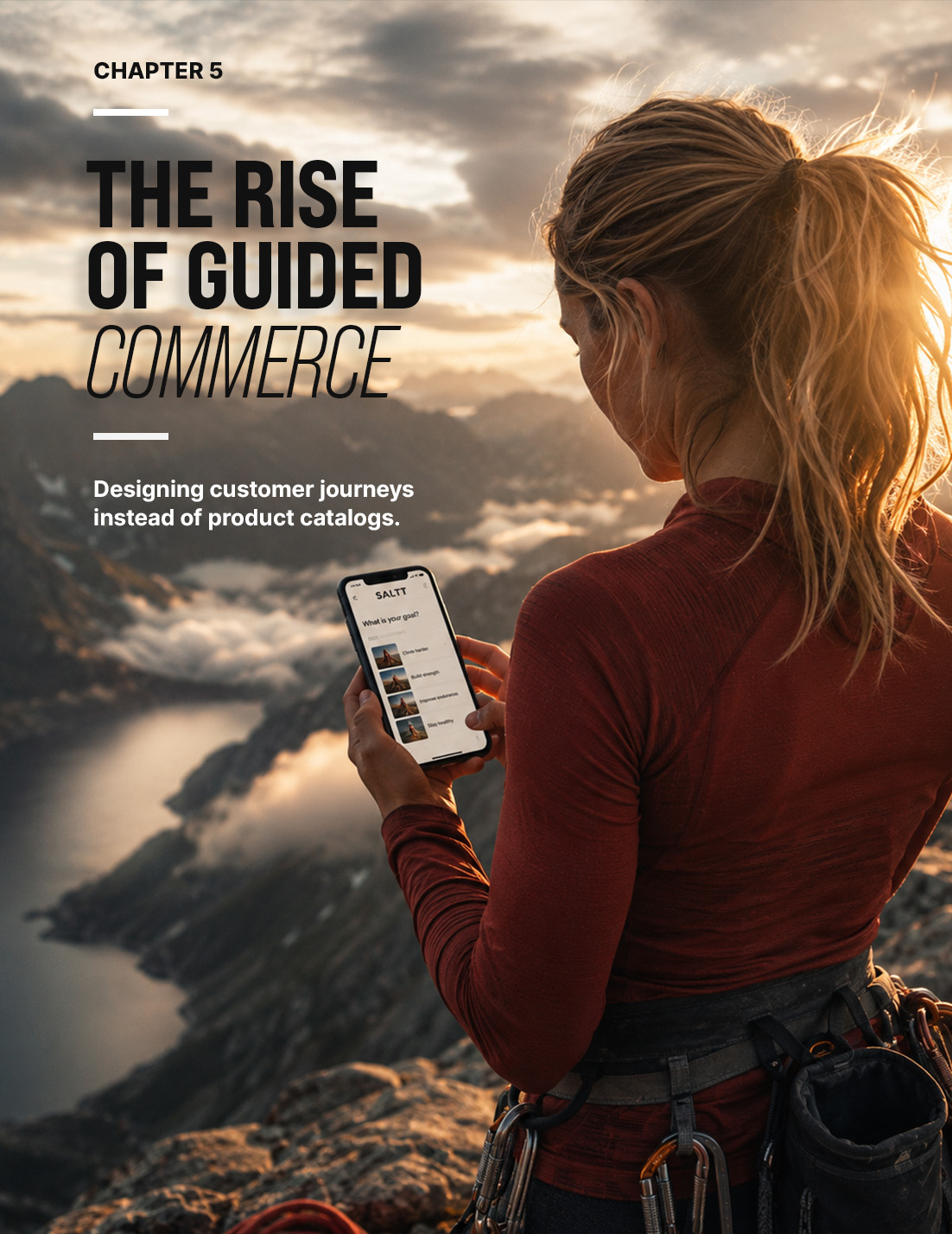
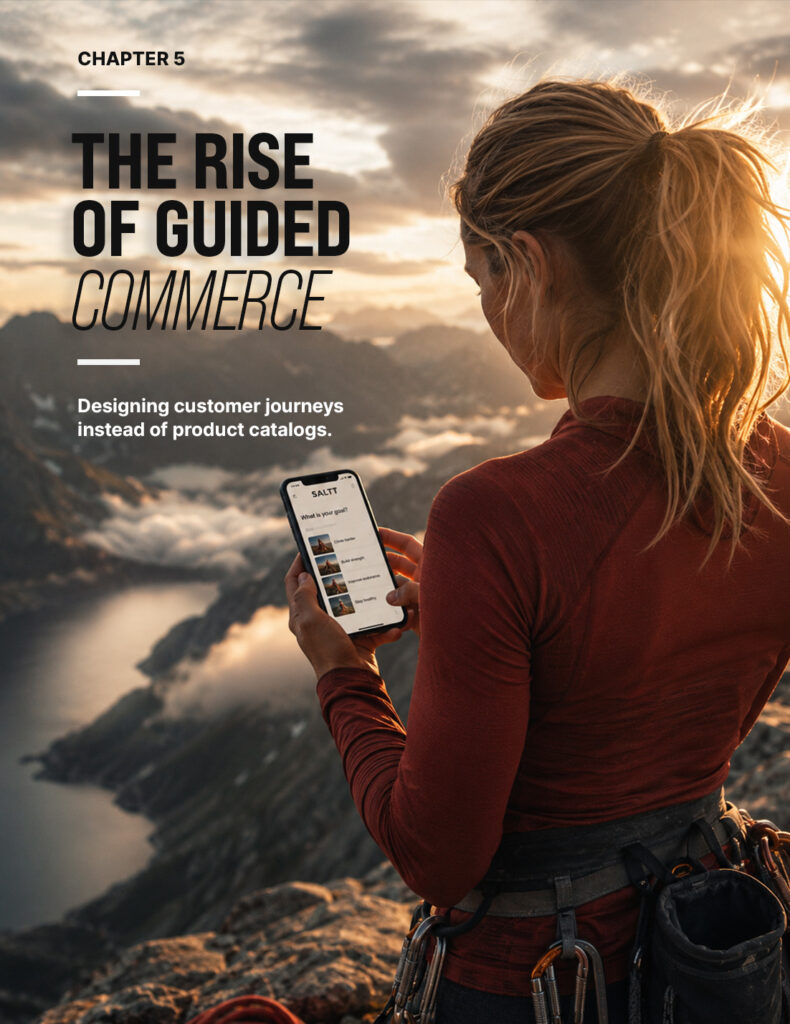
The Rise of Guided Commerce
Designing customer journeys instead of product catalogs.
Give a customer a well-organized catalog and a clear comparison chart, and you’ve solved a lot. But you’ve also left something unresolved: the customer still has to do the work of turning “here are my options” into “here’s what I should actually buy.”
For a confident, experienced shopper, that’s a small gap. For everyone else — which is most people, most of the time — it’s the exact point where they hesitate, tab away, or abandon. Most stores treat that gap as the customer’s problem to solve. Guided selling is the shift of treating that gap as the store’s problem to solve — building an actual path through the decision, instead of leaving the customer standing in the aisle.
The Old Model: The Catalog as the Interface
The default structure of ecommerce is still catalog-first: category, subcategory, filter, grid. It’s a browsing interface, and browsing interfaces put the burden of narrowing entirely on the customer. You want a product? Here are two hundred of them. Good luck.
Filters help, but filters assume the customer already knows the criteria that matter — that they can articulate what separates the right choice from the wrong one before they’ve even seen the options. For anyone new to a category, that’s an unreasonable assumption. It’s the same mismatch we saw in Chapter 3, applied to interface design instead of information architecture: the store speaks in categories and filters, the customer is thinking in outcomes and uncertainty.
The Shift: Guided Selling as the Interface
Guided selling flips the default. Instead of “here’s everything, you sort it out,” the store asks a few questions and narrows the world down to a small, confident set of answers. The customer doesn’t need expertise. They just need to answer honestly, and the store does the translation from their situation to the right product.
Field Note — SALTT
SALTT’s “Should I Mix, Drop, or Pop?” tool is a clean, small-scale example of this. Rather than presenting three product formats and expecting the customer to know which fits their routine, it asks about the customer’s actual behavior — how they train, when they need hydration, what fits into their day — and resolves that into a specific recommendation.
It’s a small mechanism, but it does something a catalog page structurally can’t: it replaces “which of these looks right to you” with “based on what you told me, here’s the one that fits.”
That’s the core move in guided selling. It’s not about adding a quiz for the sake of interactivity. It’s about recognizing that for a meaningful share of customers, the honest bottleneck isn’t a lack of options — it’s a lack of confidence about which option is right for them. The data backs this up: brands using a product recommendation quiz typically see 2 to 4x higher conversion rates from quiz traffic compared to visitors landing on a generic category page.
"A well-built guided flow removes uncertainty directly, instead of hoping better filters will do it indirectly."
Why This Matters More Than It Looks Like It Does
There’s a version of this that’s just a gimmick — a quiz bolted onto a store that ends in a generic recommendation regardless of the answers. That’s worse than no quiz at all, because it teaches the customer that their input didn’t matter. The version that works treats the guided flow as a genuine narrowing mechanism, where different answers lead to meaningfully different outcomes.
Done well, guided selling does something a static catalog never can: it makes the customer a participant in their own decision instead of a spectator sorting through a shelf. A customer who answered three questions and got a recommendation that reflects their actual situation has more confidence in that choice than one who compared five similar-looking products and picked the one with the best photo.
There’s a design discipline required to make this actually work, though, and it’s easy to underestimate. A guided flow with too many questions starts to feel like a chore, and abandonment during the flow itself becomes its own new failure point. The best versions ask the fewest questions that produce the most confident recommendation.
What To Do Differently
Not every product needs a quiz, and not every category benefits from a guided flow — for a single, well-understood product with no meaningful variation, a good product page is enough. But wherever a category has real complexity — multiple formats, use cases, or customer situations that lead to genuinely different right answers — a catalog alone is asking the customer to do work the brand is better positioned to do for them.
For endurance and wellness brands, this is especially relevant because the “right” product often depends on specifics the customer may not know how to weigh on their own — training intensity, timing, dietary constraints, existing routines. A guided flow that takes those specifics and returns a confident, specific answer isn’t a UX nicety. It’s doing the job an in-person expert would do, at scale, for every visitor.