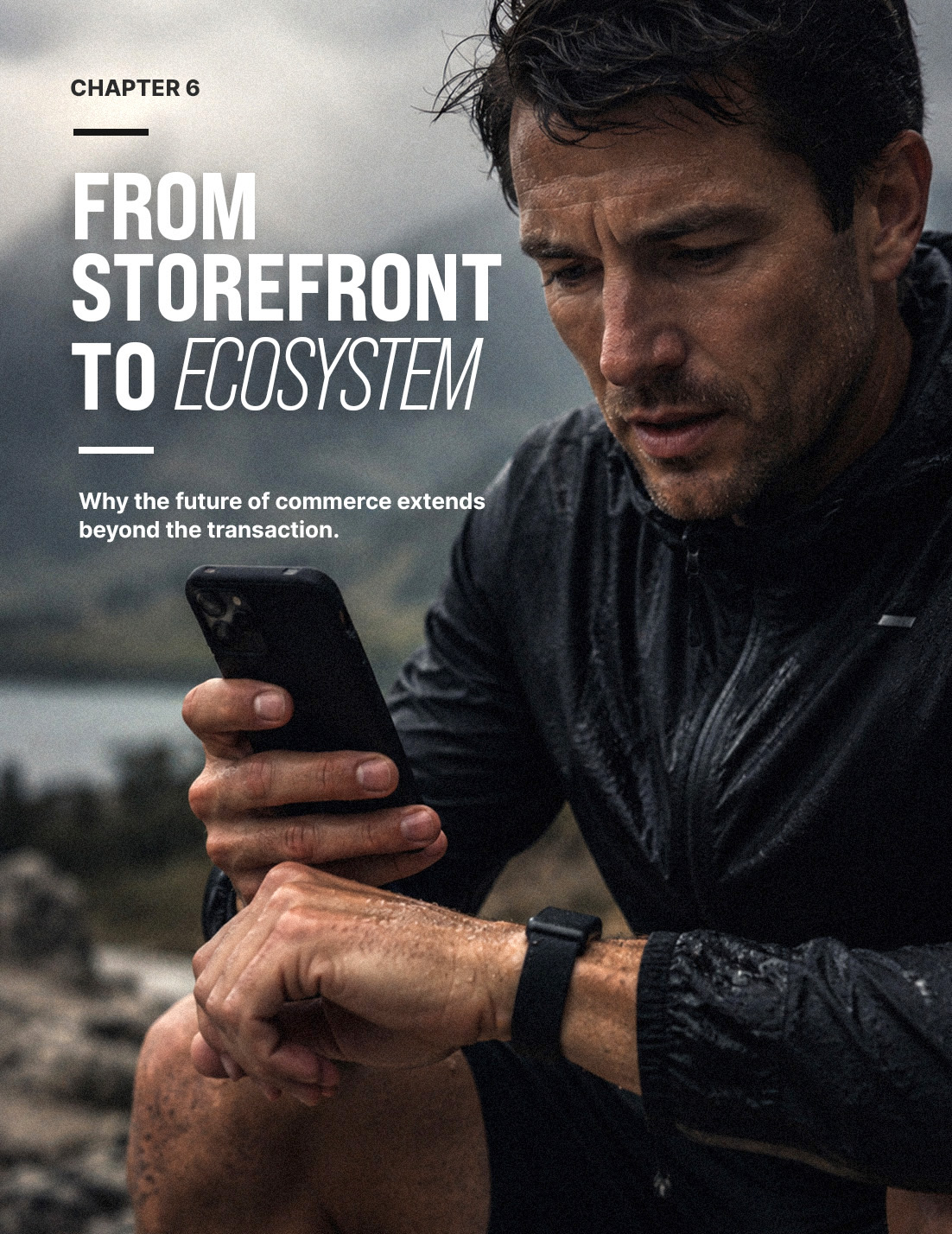
From Storefront to Ecosystem
Why the future of commerce extends beyond the transaction.
There’s a version of commerce strategy that ends at checkout. Get the customer to the site, guide them to the right product, close the sale, measure the conversion rate, repeat. Everything in the last five chapters has been about doing that better — but all of it still assumes the store’s job is to produce a transaction.
The brands pulling furthest ahead right now don’t think about their store that way at all. They don’t treat the storefront as the destination. They treat it as a single entry point into something bigger — a device, an app, a content library, a community — where the purchase is the beginning of the relationship, not the end. That’s what a real brand ecosystem looks like in practice.
The Old Model: The Storefront as Destination
For most of ecommerce’s history, this made sense as a mental model, because it matched the actual architecture of the business. The store was where the catalog lived, the transaction happened, and the relationship — such as it was — ended until the next visit. Everything downstream of checkout was retention marketing, bolted onto a business fundamentally structured around single transactions.
That structure is a ceiling. It caps how much value a brand can build with a customer, because there’s no ongoing reason for the customer to stay engaged between purchases. The relationship goes dormant the moment the order ships, and the brand has to re-earn attention from scratch every time it wants another sale.
The Shift: A Brand Ecosystem, Not Just a Storefront
The brands breaking through that ceiling have restructured the relationship so the storefront isn’t the whole business — it’s an entry point into something the customer keeps coming back to for reasons that have nothing to do with buying again.
Field Note — WHOOP
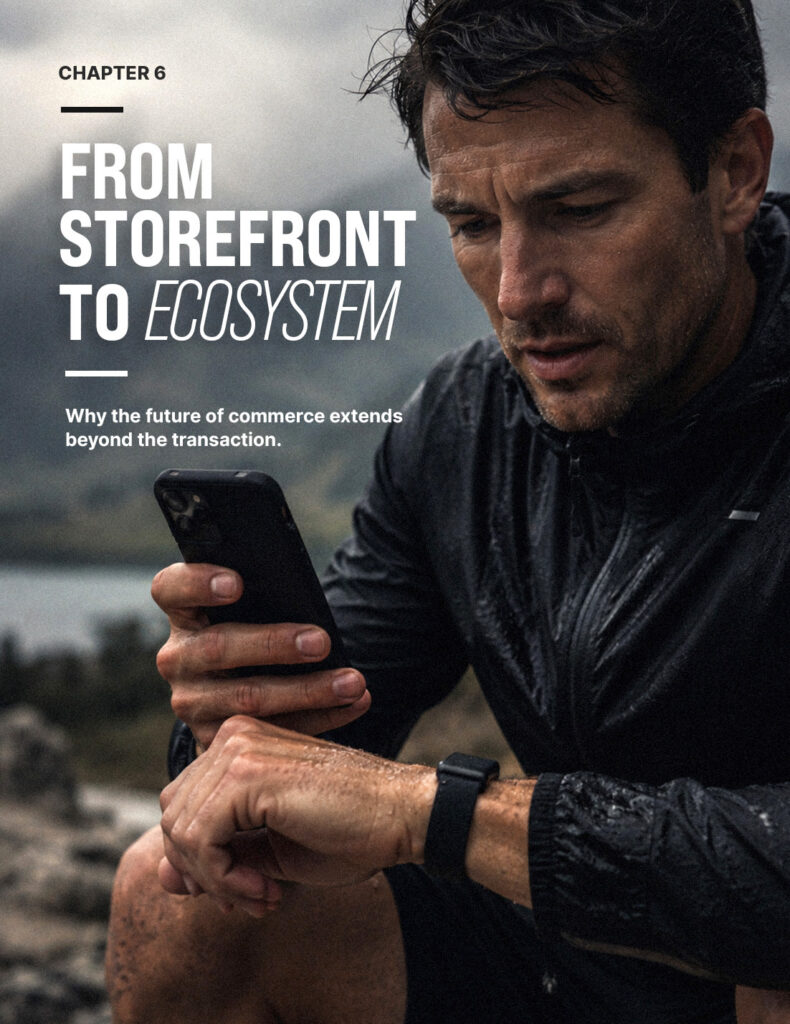
WHOOP is a useful example here, not because of a single feature, but because of how deliberately they rebuilt around this idea. Their team moved the brand away from a traditional ecommerce experience and toward what they explicitly framed as a resource for people trying to elevate their performance — less about selling a wearable, more about becoming part of how someone understands and improves themselves day to day.
The store didn’t disappear. It became one entry point into a much larger relationship built on data, content, and daily engagement.
"A store answers how do we get someone to buy. An ecosystem answers what's the relationship between purchases."
Why This Matters More Than It Looks Like It Does
A brand ecosystem changes the economics of a customer relationship in a way a storefront alone can’t. If the only reason a customer interacts with your brand is to buy something, every touchpoint is transactional, and every re-engagement requires the brand to earn attention again from a cold start.
The math backs this up: repeat customers already spend roughly 3x more per visit than first-time shoppers, while acquiring a new customer typically costs several times more than retaining an existing one. A brand with a genuine ecosystem around it keeps that relationship warm without having to re-win attention every cycle.
This also changes what competition looks like. A competitor selling a similar product at a similar price is a real threat to a storefront-only brand because price and product are the entire basis of the relationship. That same competitor is a much smaller threat to a brand with a genuine ecosystem, because the relationship isn’t only built on the product.
What To Do Differently
Start by mapping what actually happens after checkout today. For most brands, honestly, the answer is: an order confirmation email, a shipping notification, and silence until the next promotional campaign. That gap is the opportunity — it doesn’t have to be filled with hardware or a proprietary app. It can be a content library, an event series, a community, or a genuinely useful tool that has nothing to do with buying more product.
For endurance and wellness brands specifically, this is a natural fit because the category is inherently ongoing — training, recovery, and health aren’t one-time purchases; they’re continuous pursuits. A brand that shows up as part of that continuous pursuit, rather than only at the moment of purchase, is building a brand ecosystem that a pure storefront never can.