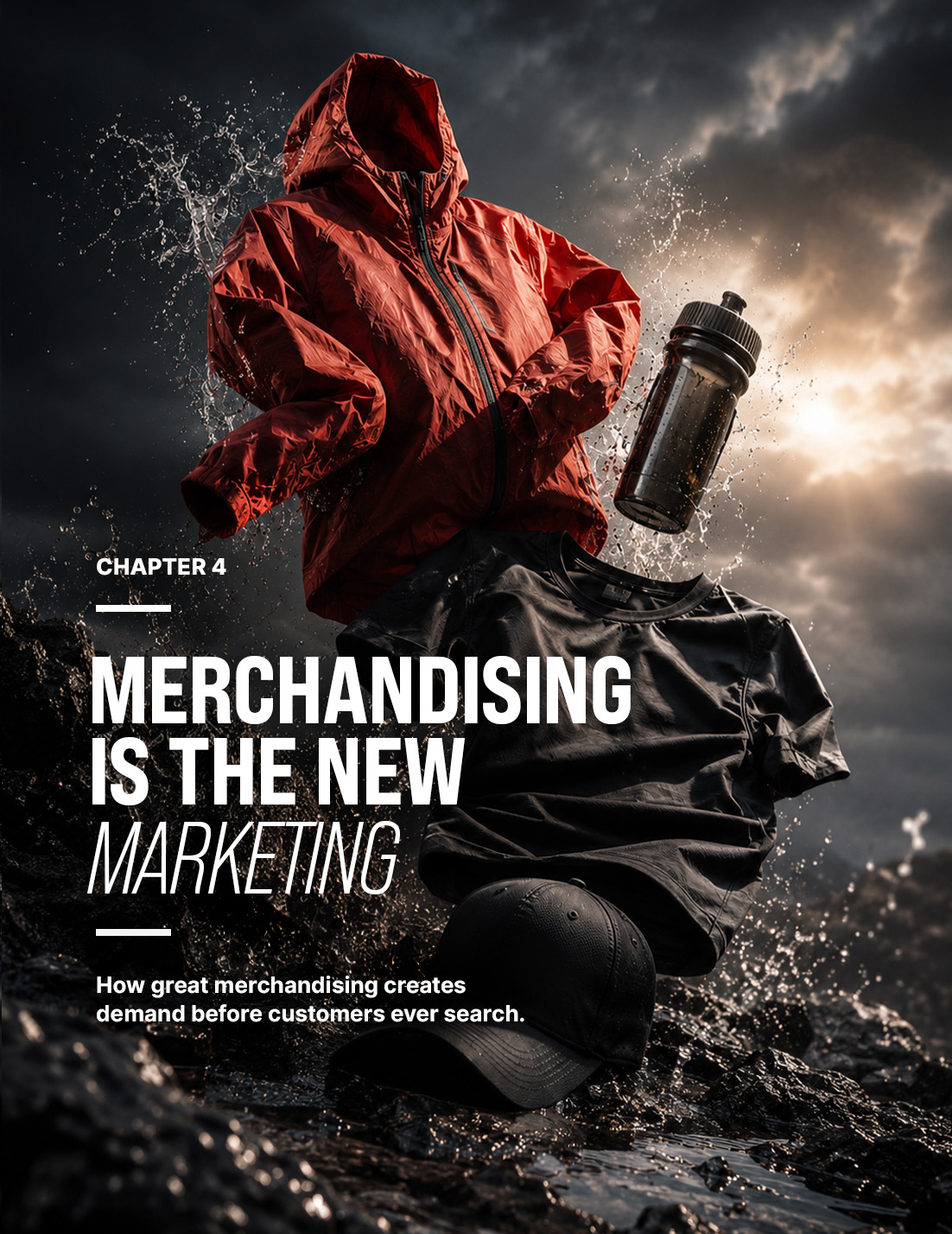
Merchandising
Is the New Marketing
How great merchandising creates demand before customers ever search.
For most of my career, merchandising and marketing have lived in separate lanes with separate owners. Marketing’s job was to generate demand — get people aware, get people interested, get people to the site. Merchandising’s job started after that: take the traffic marketing sent over and arrange it well enough to convert.
That division made sense when the store was the last stop in a journey that happened almost entirely somewhere else. But if the last chapter’s argument holds — that customers arrive thinking about outcomes, not products — then the store isn’t just receiving demand anymore. It has the opportunity to create it. And the brands doing that well aren’t relying on marketing to do it. They’re doing it through merchandising itself.
The Old Model: Marketing Generates Demand, Merchandising Fulfills It
In the traditional split, marketing owns persuasion and merchandising owns presentation. Marketing makes the case for why you need something; merchandising just needs to display the thing clearly once someone’s already convinced. It’s a reasonable division of labor on an org chart. It’s a much weaker model of how people actually make decisions once they’re standing in front of your store.
The problem with this split is that it treats the moment someone lands on a product page as a neutral moment — as if persuasion already happened upstream and the page’s only job now is clarity. But for a huge share of visitors, the persuasion is still happening right there on the page. Research on shopper behavior backs this up: in one CXL analysis of comparison-shopping behavior, the majority of consumers researching electronics considered multiple competing products and visited several brand sites before deciding — meaning the product page itself is often still doing real persuasive work, not just confirming a decision already made.
Field Note — SALTT
SALTT’s comparison chart is a clean example of this in practice. Rather than just listing their electrolyte formula’s specs, they place it directly against Liquid IV, LMNT, and Gatorade Zero — sugar content, sodium levels, ingredient sourcing, side by side.
That’s not a feature list. It’s an argument, built into the merchandising itself, doing exactly the job marketing usually claims: making the case for why this product over the obvious alternatives, before the customer ever thinks to search for a competitor’s name.
That’s the mechanism worth naming. The comparison chart isn’t there to help someone who already decided to buy SALTT confirm their choice. It’s there to intercept someone about to consider a competitor and make the case on the spot. That’s demand generation happening inside the merchandising layer, not upstream of it.
Why This Matters More Than It Looks Like It Does
Most brands still measure merchandising’s success by conversion rate on existing traffic — did the page do its job once someone arrived? That’s a real metric, but it undersells what good merchandising can actually do. When merchandising builds the case for a category or an outcome, it starts doing work that reduces how much marketing has to manufacture demand from scratch.
"You don't need a bigger ad budget to build a better comparison chart. You need to be honest and specific about why you're different."
Think about what the comparison chart actually accomplishes. It’s not just persuading the visitor sitting on that page right now. It’s building a mental model that visitor will carry into every future comparison they make — every time they see a competitor’s ad, every time a friend mentions a different brand.
This is also a more cost-efficient way to compete. Going head-to-head with bigger competitors on paid acquisition is expensive and, for most challenger brands, a losing game against companies with more budget. That’s a lever available to any brand willing to be honest and specific about why they’re different.
It’s worth being honest about the risk here too. A comparison chart only builds trust if it’s actually fair — if it names real trade-offs instead of stacking the deck with cherry-picked specs. Customers can tell the difference between a brand confident enough to compare honestly and a brand gaming the presentation, and the second version does more damage than no comparison at all.
What To Do Differently
Look at your product pages and ask a blunt question: if a customer landed here having never heard of us, would this page make the case on its own? Not “does it look clean” — does it actually persuade? If the honest answer is no, that’s not a marketing gap. It’s a merchandising gap, and it’s often cheaper and faster to close than another campaign.
For endurance and wellness brands specifically, this matters because the category is crowded with claims that all sound similar from a distance. A well-built comparison chart, a clear “why this and not that,” a benefits framework that maps directly to what the customer is trying to solve — these are merchandising decisions that function as marketing, and often outperform marketing built separately from the product experience.