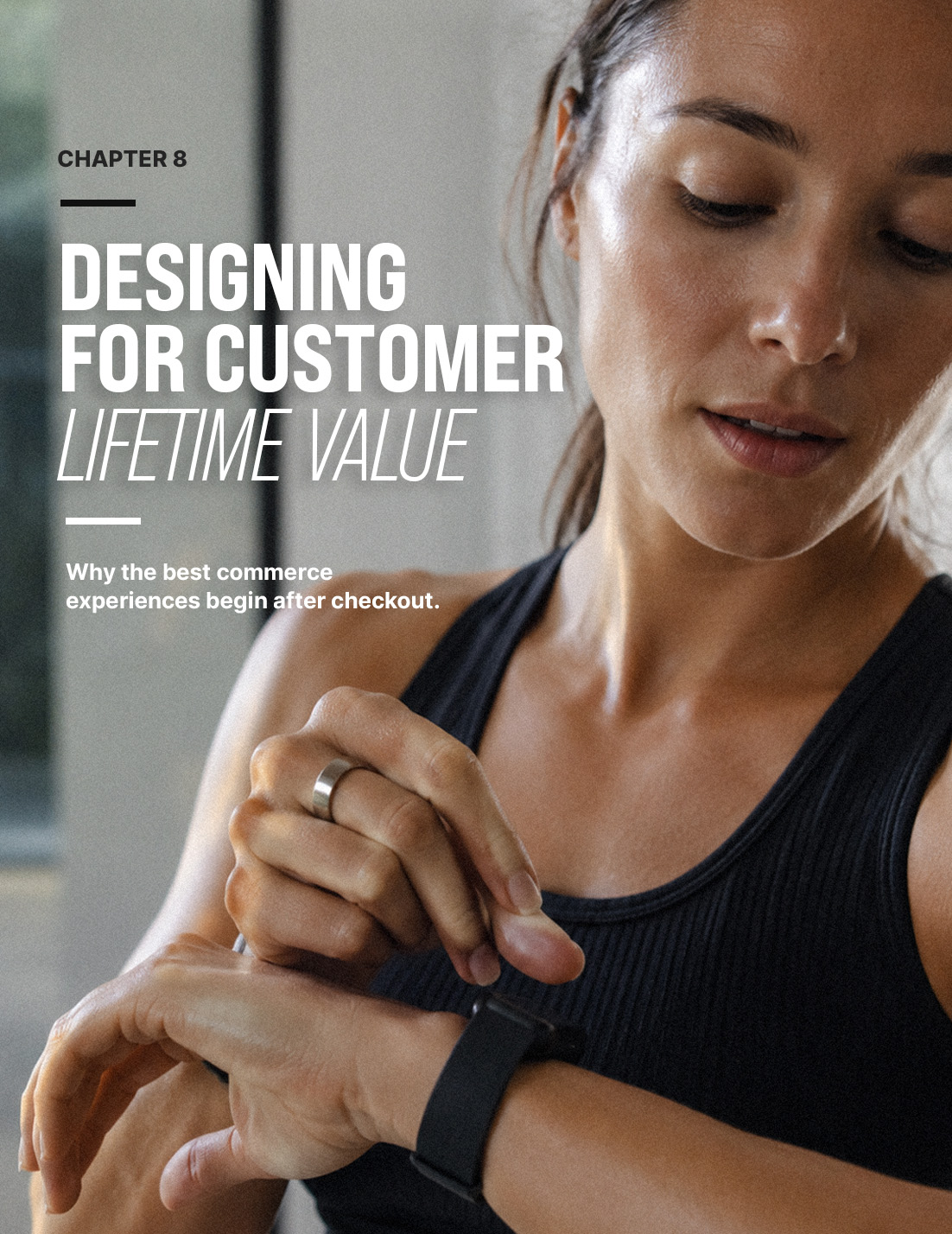
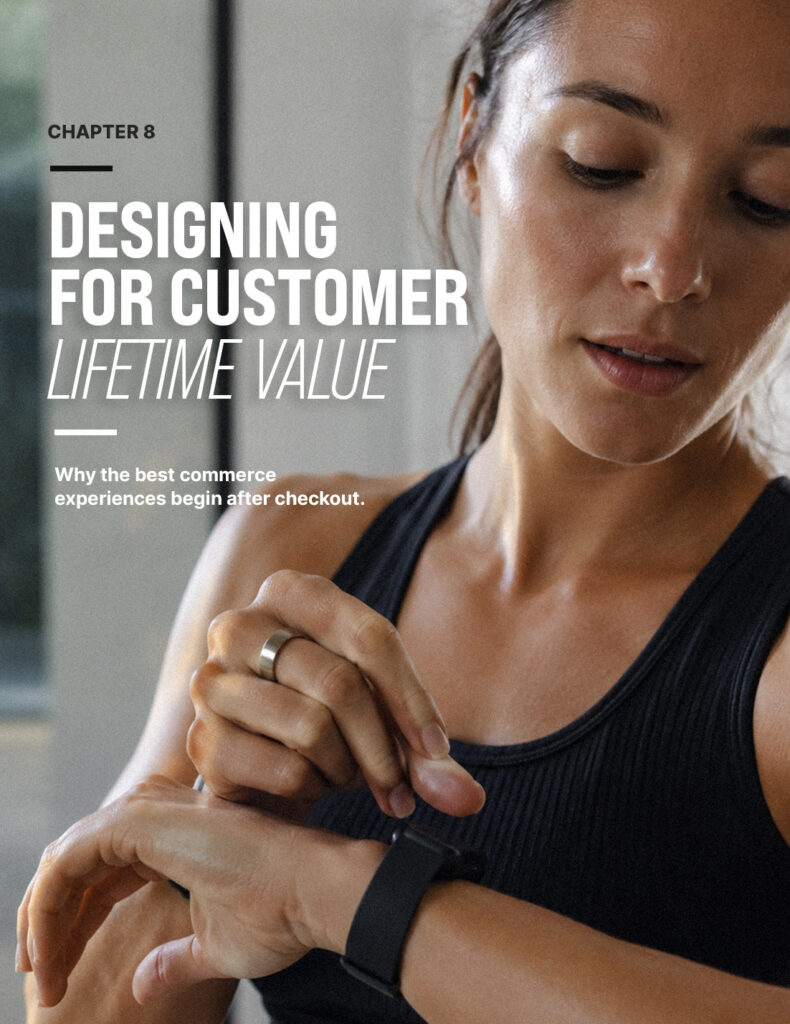
Designing for Customer Lifetime Value
Why the best commerce experiences begin after checkout.Almost every resource a brand has goes toward the moment before checkout. The site design, the merchandising, the guided flows, the personalization — everything we’ve covered so far in this book is aimed at getting someone to that single click. And then, for most brands, the investment just stops. An order confirmation email goes out, a shipping notification follows, and the carefully designed experience that got the customer there simply ends.
That’s backwards. Checkout isn’t the finish line of the relationship. It’s the only point in the entire journey where you can say with certainty that the customer trusts you enough to hand over money. Customer lifetime value — everything interesting about the relationship — is still ahead of you at that moment.
The Old Model: Checkout as the Finish Line
The traditional commerce funnel treats the purchase as the objective. Every metric, every optimization, every dollar of design and marketing spend is justified by its effect on conversion. Once the order is placed, the business, structurally, moves on — inventory gets fulfilled, and the customer becomes a line in a database until the next campaign tries to win their attention back.
This isn’t a failure of intention. It’s a natural consequence of measuring what happens before the purchase far more precisely than what happens after it. Conversion rate is easy to track. What happens to the relationship in the weeks and months after checkout is harder to measure — so it doesn’t get designed either.
The Shift: Checkout as the Starting Line
The brands building durable customer lifetime value have inverted this. They treat the moment right after purchase as the beginning of the most important design work they’ll do, not the end of the work they’ve already done.
Field Note — OURA
Oura is the clearest version of this I’ve come across. The ring itself — the hardware, the actual transaction — is explicitly the entry ticket, not the destination. The real relationship lives in the membership that follows: daily insights, personalized guidance, an ongoing reason to open the app and engage with your own data every day.
What’s notable isn’t just that Oura built a subscription on top of a hardware purchase — plenty of companies do that without the retention to show for it. Independent analysis of Oura’s business found that more than 80% of members renew their membership after the first year, in a wearables category where subscription fatigue is common enough that competitors have built entire marketing campaigns around going subscription-free.
That’s the inversion worth sitting with: post-purchase isn’t a support function bolted onto the business. For brands doing this well, it’s the actual product.
"The product customers are loyal to isn't the object they bought. It's the relationship the object gave them access to."
Why This Matters More Than It Looks Like It Does
There’s a math problem underneath all of this that’s easy to lose sight of: acquiring a new customer is almost always more expensive than deepening the relationship with one you already have. Every dollar spent designing a better post-purchase experience increases the value of a customer you’ve already paid to acquire once.
Beyond the economics, there’s something more durable being built. A customer whose relationship with a brand ends at checkout has no reason to develop loyalty beyond price and convenience — the two things a competitor can always undercut. A customer with a genuine post-purchase relationship has a reason to stay that a competitor can’t simply match with a discount.
This is a lesson worth carrying back to the personalization argument from the last chapter too — the same data that lets a store adapt before purchase can keep adapting after it, which is exactly what turns a one-time buyer into an ongoing member.