The Commerce Operating System
The future of Shopify, customer experience & digital merchandising.Nine chapters ago, this book opened with a claim: we don’t have a product discovery problem; we have an inspiration problem. Everything since has been an argument for what follows from that one reframe — that customers arrive without fixed intent, that search is a late-stage tool, that they’re buying outcomes rather than products, that merchandising can generate demand on its own, that journeys serve them better than catalogs, that the relationship extends past the transaction, that personalization can replace navigation, that the real value shows up after checkout, and that none of it can be measured honestly with conversion rate alone.
Taken individually, each of those is a design decision. Taken together, they’re something bigger: a different theory of what a commerce platform is actually for. If all nine of these shifts are real, what does the infrastructure underneath them need to look like to actually support a business built this way? That’s what a real commerce operating system has to answer.
The Old Model: Platform as Transaction Infrastructure
Most commerce platforms, at their core, were built to solve a narrower problem than the one this book has been describing. Cart. Checkout. Payments. Inventory. Order management. That’s an essential job, and it’s one that platforms like Shopify have gotten remarkably good at. But it’s infrastructure built for the old model — the one where the store’s job ends at the transaction.
You can build a genuinely excellent transaction engine on that foundation and still be structurally unable to support inspiration-led discovery, AI-driven personalization, guided journeys, or a real post-purchase relationship — not because the platform is bad at what it does, but because what it does was never the whole job to begin with.
Field Note — The Four Case Studies
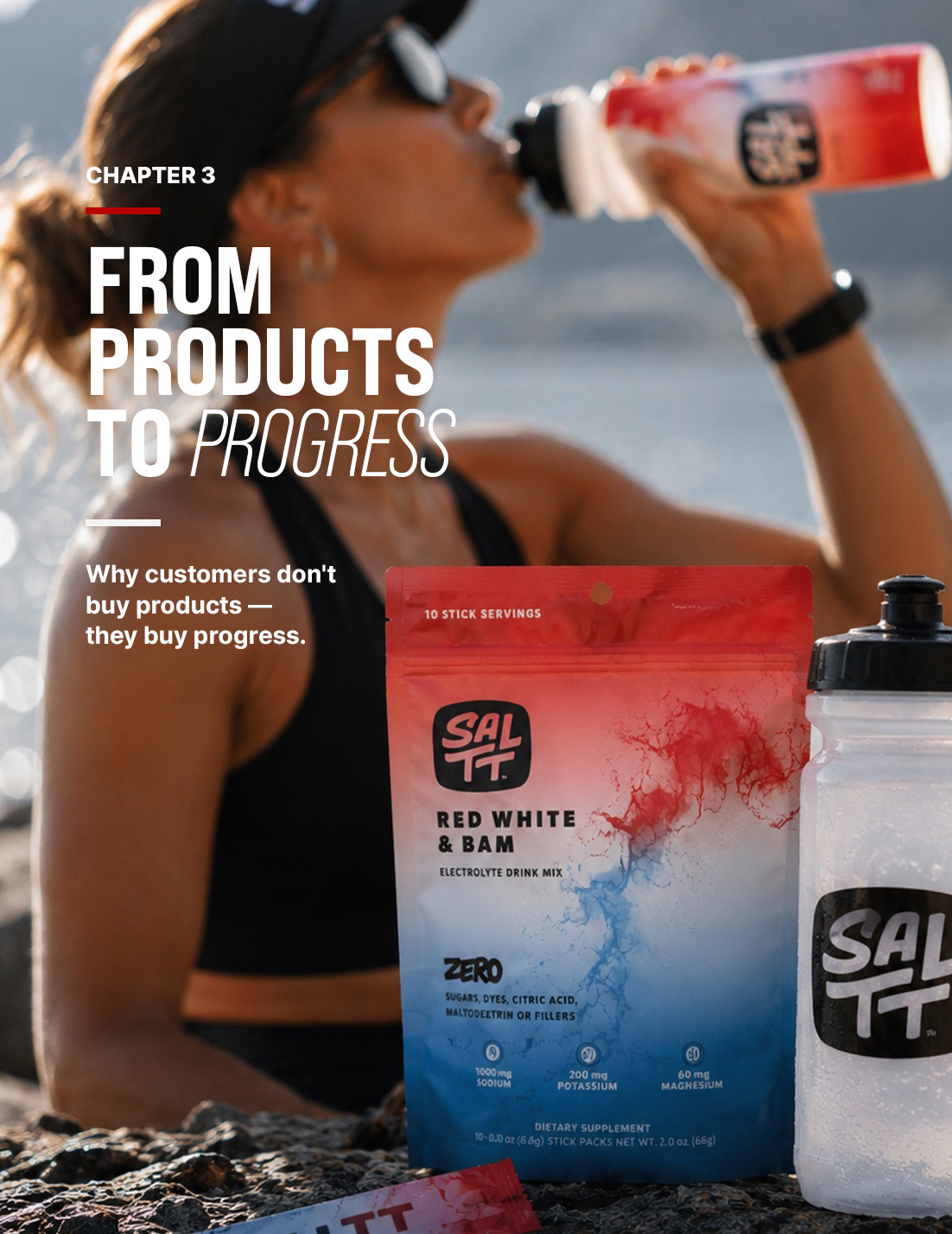
This is where the examples running through this book come together. IRONMAN’s rebuild reimagined discovery and navigation around athlete goals — the front end of the operating system, replacing findability with inspiration. SALTT’s benefit-based merchandising and guided selling tools show what the merchandising layer looks like when it’s built to do real persuasive work, not just display products.
WHOOP’s rebuild shows the personalization and ecosystem layer — a platform that adapts to who’s visiting and extends the relationship past a single storefront visit. And Oura shows what the whole system is ultimately optimizing for: not a transaction, but a durable, high-retention relationship that the platform has to be built to sustain.
"Commerce by design isn't a slogan. It's a discipline: treating every layer of the customer relationship as something worth building intentionally."
Why This Matters More Than It Looks Like It Does
Platforms shape what’s possible before a single design decision gets made. A team working on infrastructure built purely for transactions will keep finding themselves fighting the platform every time they try to build inspiration-led discovery or a genuine post-purchase experience — not because the team lacks the ideas, but because the foundation wasn’t built to hold them.
This is also, ultimately, an organizational question as much as a technology one. Businesses that treat their platform as transaction infrastructure tend to organize their teams the same way — a merchandising team, a marketing team, a retention team, each optimizing their own narrow slice. Businesses that treat their platform as an operating system tend to organize around the customer’s actual journey instead.
Where This Leaves Us
Ten chapters ago, the argument started with a simple claim: customers don’t need better findability; they need real inspiration. Everything since has been the case for what it takes to build a business around that claim seriously — not as a single feature, but as a coherent philosophy that touches discovery, merchandising, journeys, ecosystems, personalization, lifetime value, and the metrics used to measure all of it.
That’s the throughline of this book, and it’s the throughline of the work behind it — most visibly in the IRONMAN rebuild and in every brand studied alongside it along the way. The next decade of commerce belongs to the brands that understand this distinction early. The rest will keep optimizing checkout flows and wondering why growth has slowed.