Key takeaways
- Define the audience and the one idea they need to understand before producing a scene.
- Use storyboards to make invisible processes visible in a clear sequence.
- Treat AI-generated anatomy and product details as material requiring expert verification.
- Extend the same visual system into presentations, websites, campaign assets and social content.
Some of the most important stories in healthcare are also the hardest to explain. How does a device work? What happens during a procedure? What should someone expect? Medical illustration and motion can make an invisible process easier to follow—and AI-assisted production expands the visual possibilities.
Why do medical explainer videos matter?
Healthcare audiences need different levels of detail. A patient learning about a treatment asks different questions than a clinician evaluating a device or a team introducing a healthcare innovation. The same subject may need several explanations.
An effective explainer starts with the audience and one clear communication objective. It can visualize anatomy, demonstrate intended product operation, introduce a treatment concept or support professional education. Its purpose is not to add more detail; it is to make the relevant detail understandable.
How does medical illustration make complex ideas clearer?
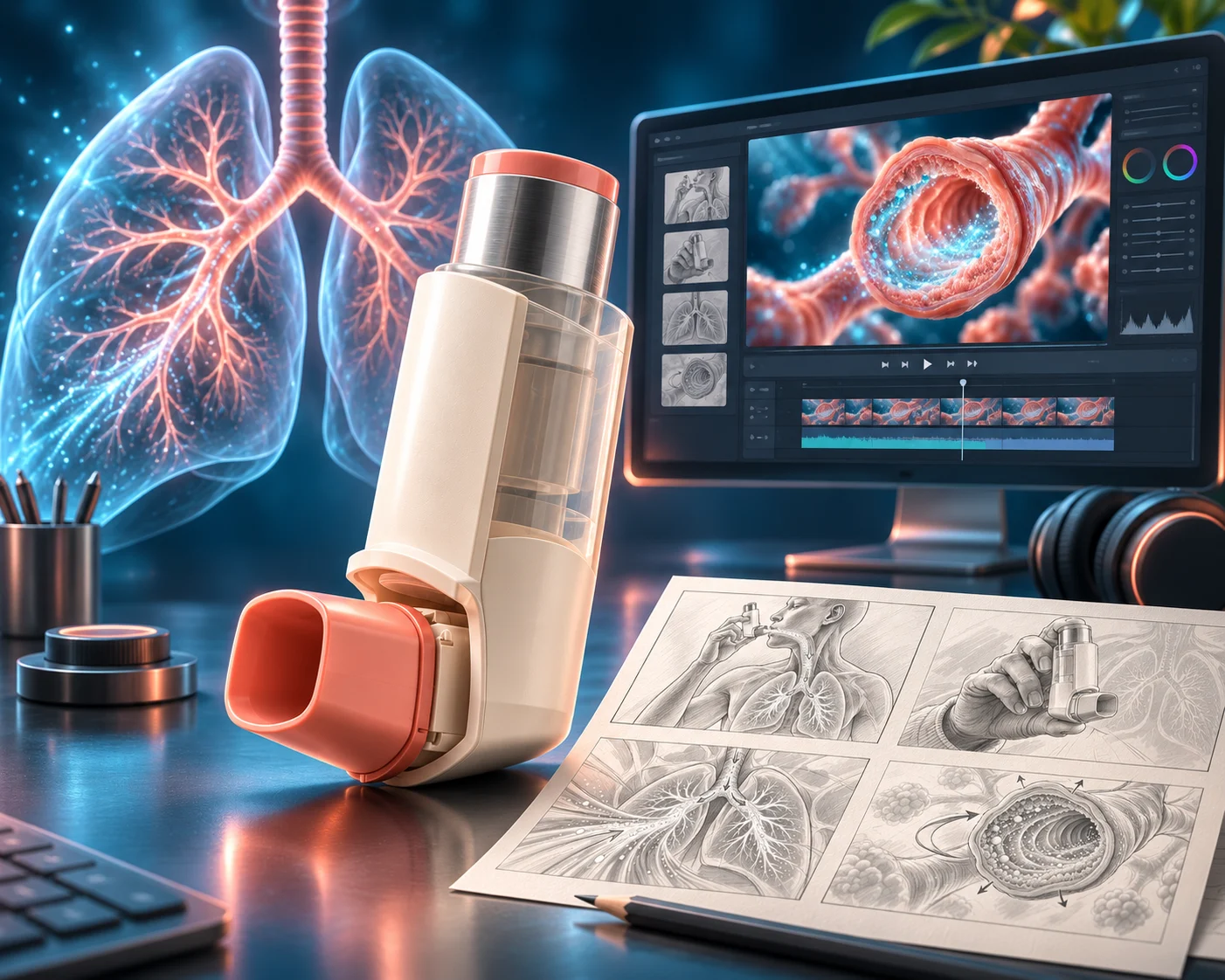
Illustration lets a story move beyond the limits of conventional filming. A sequence can reveal structures inside the body, isolate a product component or follow a process from one stage to the next. Motion gives those visuals order and context.
For example, a respiratory explainer can move from a recognizable inhaler to an illustrated view of the airways. The sequence helps orient viewers before introducing technical information. Each frame should answer a question rather than compete for attention.
Where does AI fit into medical video production?
AI-assisted creative tools can support early visual exploration, environment development, scene concepts and selected production tasks. They can help teams visualize scenes that would be difficult or expensive to film physically.
But a generated image is not evidence of a medical fact. Anatomy, mechanisms of action, device features and clinical claims require reliable references and qualified review. Human creative direction is responsible for the narrative, consistency, pacing and final quality.
The technology can help create the imagery. Human direction determines whether the story makes sense.
What is the process from storyboard to screen?
A purposeful explainer follows a sequence of decisions, not a collection of impressive shots.
- Define the audience and outcome. Identify what viewers should understand and what they should do next.
- Write and storyboard. Map the narrative, visual sequence, narration and moments requiring technical validation.
- Develop the visual language. Align illustration, color, typography, motion and product depiction with the brand.
- Produce and refine. Combine approved illustration, AI-assisted imagery where suitable, animation, compositing and editing.
- Review and finish. Check clarity, accuracy, accessibility, pacing, sound and consistency; seek expert and regulatory review as required.
How does AERIVA bring the approach to life?
AERIVA is a HOUSEINK Studio respiratory healthcare creative concept, developed to explore how a product story could connect medical visualization, identity and experience design. It is not a clinically validated medical product demonstration.
Its visual world brings together an inhaler, respiratory illustration, AI-assisted explainer imagery, brand identity, packaging and app concepts. The point is not the number of assets. It is how each touchpoint supports the same story.
Explore the AERIVA creative concept and see how its branding, motion and product visuals connect.
How can one explainer become a connected content system?
A medical explainer can introduce a product or topic, while supporting illustrations clarify features, short motion sequences adapt the story for social channels, a webpage provides deeper context and a presentation supports professional discussions.
Developed together, these pieces create continuity across the entire journey. The story stays recognizable even as the format and level of detail change.
That is how HOUSEINK approaches creative production: one idea, thoughtfully adapted to the places where people discover, evaluate and understand it.
Better medical communication starts with clarity. AI widens what we can visualize; good storytelling makes those visuals useful. Explore HOUSEINK AI Creative Production or start a conversation about a story worth explaining.
Frequently asked questions
What is an AI medical explainer video?
It is a healthcare explanation developed with scripting, medical illustration, animation and editing, with AI-assisted tools supporting parts of the visual production. Human direction and appropriate medical review remain essential.
Can AI create medically accurate illustrations?
AI can help develop concepts, but generated anatomy and medical processes are not automatically accurate. Qualified subject-matter experts should review visuals and claims before real-world medical use.
How are medical explainer videos made?
The process typically includes defining the audience, scripting, storyboarding, visual design, animation or video production, editing, and clinical or regulatory review where appropriate.
Who uses medical explainer videos?
Medical device companies, healthcare providers, research teams, digital health brands and patient education programs can use them to explain information to different audiences.
Can one medical explainer support a larger campaign?
Yes. Its visual language can support short videos, diagrams, presentation content, websites and marketing materials, with each format adapted to its audience and purpose.